

Table of Contents
Let’s get one thing straight: your AI writing assistant is a genius. It can draft a 1,000-word article on quantum physics or a catchy social media post in the time it takes you to brew your morning coffee. It’s a brilliant researcher, a lightning-fast organizer, and an unparalleled productivity hack. But let’s be honest—it’s a terrible finisher.
AI-generated content, straight out of the box, often has the personality of a toaster. It’s grammatically perfect, logically structured, but utterly devoid of soul. It uses phrases like “in the digital landscape” and “it is imperative to,” which no human actually says in conversation. This is where most creators get stuck. They have a solid draft, but it sounds like it was written by a robot, for a robot.
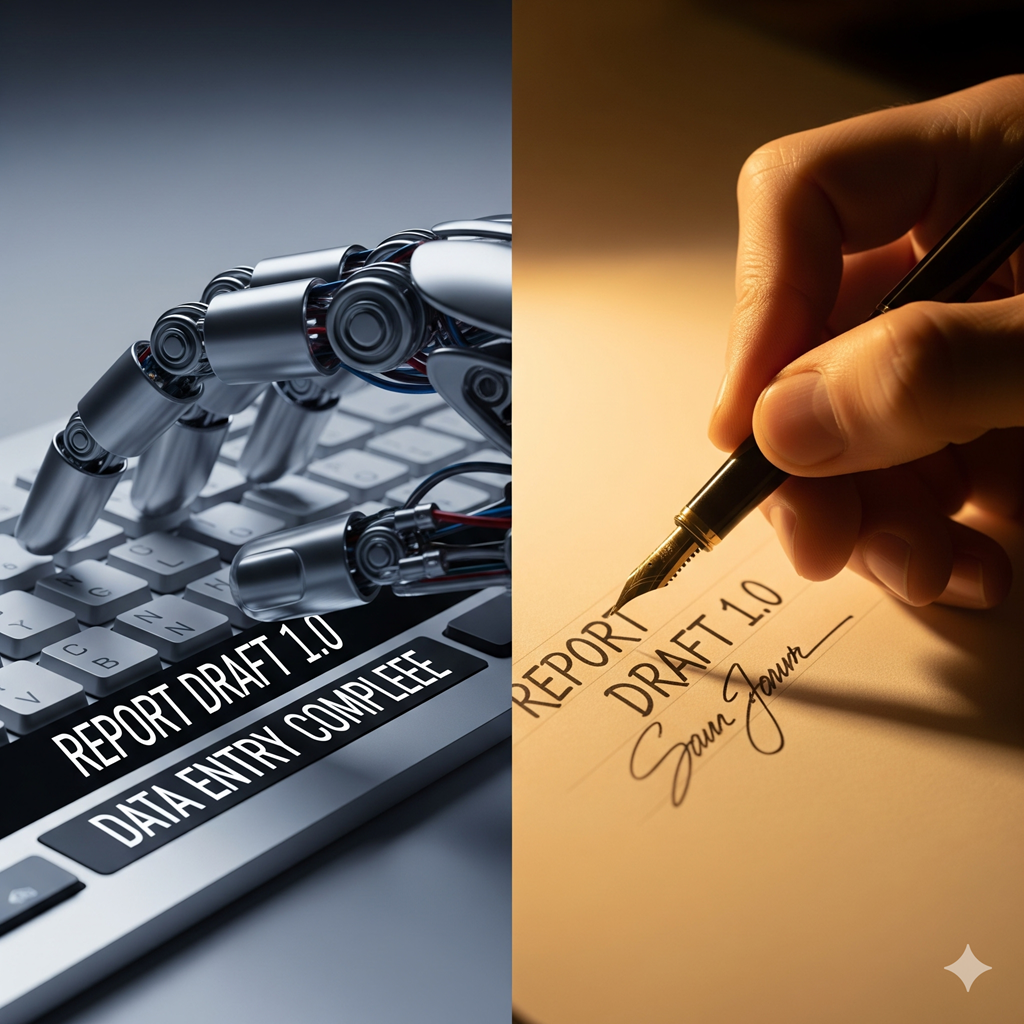
The secret to bridging this gap isn’t a better prompt. It’s you. It’s your Organic Intelligence (OI)—that uniquely human blend of experience, humor, storytelling, and style. AI gives you the clay; OI is what molds it into a masterpiece.
If you’re tired of your content sounding generic, this guide is your roadmap. We’ll walk through the essential steps to edit AI content, transforming it from robotic rambling into writing that is undeniably, authentically you.
Step 1: Define Your Brand Voice (Before You Even Start Editing)
You can’t inject personality if you haven’t defined what that personality is. Before you review a single line of AI text, you need a clear understanding of your brand voice. This is your North Star for every edit you make. Don’t overcomplicate it. Start by choosing 3-4 core characteristics.
Are you:
- Witty and Ironic?
- Empathetic and Nurturing?
- Authoritative and Direct?
- Minimalist and Poetic?
- Enthusiastic and Encouraging?
Once you have your keywords, every edit should serve to align the text with those traits.
Before (Generic AI):
“It is important for businesses to utilize effective content strategies to engage their target audience and foster growth.”
After (Edited for a “Witty and Authoritative” Brand Voice):
“Look, if your content isn’t connecting, you’re basically just shouting into the digital void. Let’s talk about how to stop wasting your breath and actually get people to listen.”
See the difference? The core message is the same, but the “After” version has a pulse. This is the first and most crucial part of AI content refinement.
Step 2: Inject Your Stories and Anecdotes
AI has access to nearly all the information on the internet, but it doesn’t have your memories. It’s never bombed a presentation, celebrated a surprise client win, or learned a tough lesson the hard way. Stories are what make us human, and they are your most powerful tool to make AI content sound human.
Scan your AI-generated draft for generic statements or abstract points. These are prime opportunities to swap out bland facts for compelling personal anecdotes.
Before (Generic AI):
“Consistency is a key factor in achieving long-term goals. By maintaining regular habits, individuals can see significant progress over time.”
After (Edited with a Personal Anecdote):
“I used to think ‘consistency’ was a buzzword for people with way more willpower than me. Then I committed to writing for just 15 minutes every single day. Most days, it felt like nothing. But after six months, I had a full manuscript. It wasn’t one grand gesture; it was the tiny, boring, daily commitment that built the entire thing.”
Personal stories build trust and create an emotional connection that no natural language processing model can replicate on its own.
Step 3: Hunt Down Generic Phrases and Make Them Yours
Every AI writing assistant has its tells—pet phrases and sentence structures that scream “I’m a robot!” Your job is to become a detective and hunt them down.
Common culprits include:
- “In conclusion…”
- “Furthermore…”
- “It is essential to note…”
- “Unlock the potential of…”
- “In today’s fast-paced world…”
Replace these with your own unique phrasing. How would you transition to a new idea? What metaphors or analogies do you naturally use?
Before (Generic AI):
“In order to succeed, one must leverage a multi-faceted approach, combining both innovation and strategic planning.”
After (Edited with a Unique Voice):
“Success isn’t a one-trick pony. You can’t just have a great idea and hope for the best. You need to be both the dreamer with the wild ideas and the architect who actually draws the blueprints.”
This is one of the most practical content editing tips for AI-generated text. It instantly makes the writing more dynamic and less predictable.
Step 4: Read It Out Loud for Rhythm and Flow
This might be the most underrated editing technique in existence. Your eyes will forgive clunky sentences and awkward phrasing that your ears will catch immediately.
After you’ve edited for voice and added your stories, read the entire piece out loud.
- Do you stumble over certain sentences? They’re too complex. Simplify them.
- Does it sound monotonous? Vary your sentence length. Mix short, punchy statements with longer, more descriptive ones.
- Does it sound like something you’d actually say to a friend or colleague? If not, rewrite it until it does.
Before (Clunky AI):
“The implementation of these advanced techniques will facilitate a subsequent optimization of your workflow, resulting in increased efficiency.”
After (Edited for Natural Flow):
“Putting these techniques into practice will completely streamline your workflow. You’ll just get more done, faster.”
The AI is Your Assistant, You Are the Artist
Think of AI as the most capable intern you’ve ever had. It lays the groundwork, organizes the structure, and hands you a solid B-minus draft. But it’s your Organic Intelligence (OI) that takes that draft and turns it into A-plus work. It’s your insight, your humor, and your humanity that will make people stop scrolling and actually feel something.
So don’t be afraid to slash and burn. Delete entire paragraphs. Rewrite sentences from scratch. Challenge the AI’s logic. The goal isn’t to just edit AI content—it’s to claim it, to infuse it with your spirit, and to make it undeniably yours. The machine gives you a starting point, but you are the one who creates the art.