

Table of Contents
We are living through a very specific, very loud moment in history where everyone is obsessed with using Artificial Intelligence, but a surprisingly small group of smart entrepreneurs are focused on owning the interface.
You see the headlines. You see the screenshots of ChatGPT conversations. But what you might be missing is the quiet shift happening in the background. While the masses are paying $20 a month to a giant corporation for a generic chat interface, savvy digital architects are building specialized, niche “AI Wrappers” and charging for them.
And the best part? You don’t need to be a Silicon Valley developer to do it. You don’t even need to know how to code. If you can manage a WordPress site, you can build a recurring revenue machine.
The “AI Wrapper” Business Model Explained (Simply)
Let’s strip away the jargon. An AI Wrapper is essentially a specialized interface that sits on top of a powerful AI model (like OpenAI’s GPT-4, Claude, or Gemini).
Think of the raw AI models as a wholesale warehouse full of ingredients. It’s messy, overwhelming, and not everyone knows how to cook with it. An AI Wrapper is the restaurant. You take those ingredients, package them into a specific menu (a specific solution), and serve it to a hungry audience in a comfortable setting.
Why would someone pay you when they can use ChatGPT for free?
Specificity.
A generic chatbot is confusing for a dentist who just wants to write patient follow-up emails. But a tool called “DentistMail Pro” that has a simple form asking for the patient’s name and procedure type, and then generates a perfect email instantly? That dentist will happily pay $19/month for that convenience and precision.
That is the Micro-SaaS (Software as a Service) opportunity. And until recently, you needed to hire a developer or learn complex “no-code” bubble environments to build one. Not anymore.
Why WordPress is Your Secret Weapon
Most people think of WordPress as a blogging platform. That’s a mistake. WordPress is the operating system of the web, powering over 40% of all sites. When you combine the flexibility of WordPress with the right engine, you eliminate the biggest barrier to entry in the software business: Development Costs.
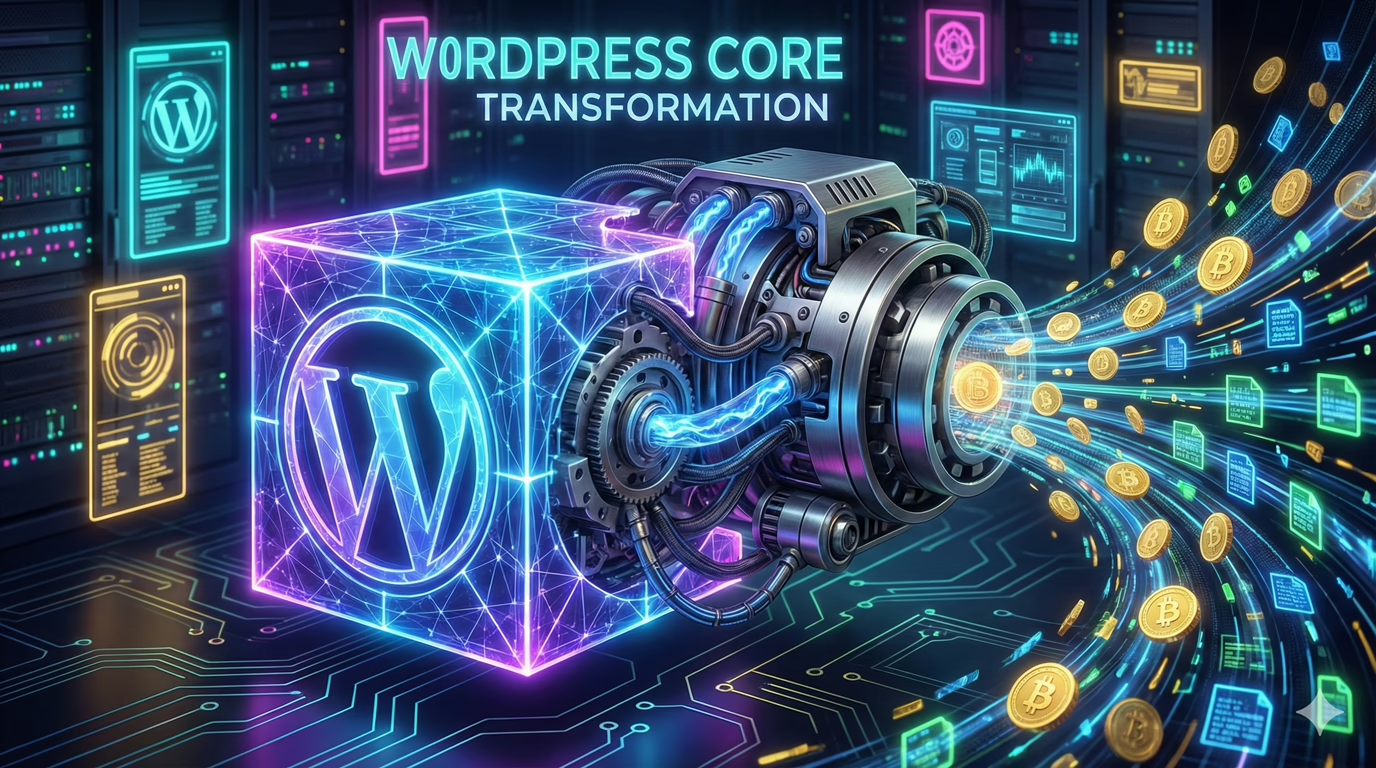
By using a dedicated engine—specifically designed to turn WordPress into a SaaS platform—you bypass months of coding. You install a plugin, configure your settings, and suddenly, you aren’t just a website owner; you are a software vendor.
This approach offers you three massive unfair advantages:
- Speed to Market: You can go from “idea” to “accepting credit cards” in a single afternoon.
- Total Ownership: Unlike building on rented land (like some expensive no-code platforms that charge you more as you grow), you own your data, your users, and your platform.
- The BYOK Model: This is the financial game-changer.
The Economics of “Bring Your Own Key” (BYOK)
Traditional SaaS founders lose sleep over API costs. Every time a user generates a text or an image, it costs the founder money. If a user goes viral, the founder might go bankrupt.
The smart play—and the one we advocate for—is the BYOK (Bring Your Own Key) model.
In this scenario, your software requires the user to plug in their own OpenAI or Anthropic API key. This means the heavy lifting (the cost of intelligence) is paid directly by the user to the AI provider. You, the SaaS owner, charge a subscription fee for the access to your specialized tools, prompts, and interface.
Your margins remain 100%. Your running costs are virtually zero. It is the closest thing to a perfect business model that currently exists.
Finding Your Million-Dollar Micro-SaaS Idea
You might be thinking, “Okay, the tech is easy, but what do I build?”
The trap most people fall into is trying to build “The Next ChatGPT.” Don’t do that. You can’t beat them at being general. You beat them by being hyper-specific.
Look for expensive problems in boring industries.
- Real Estate: Agents spend hours writing listing descriptions. Build a tool where they upload photo details, and it spits out luxury listing copy.
- HR Departments: Writing rejection letters is emotionally draining. Build a “Compassionate HR Assistant” that drafts polite emails based on candidate notes.
- eCommerce: Shop owners need product descriptions. Build a “Shopify SEO Describer” that takes a product title and generates 300 words of SEO-optimized copy.
To validate these ideas properly, you need a system. You can’t just guess. Using a structured approach like the Digital Product Launchpad ensures you aren’t just building a tool, but launching a market-dominating system that targets a verified pain point. It helps you design the “Desire Architecture” so your tool sells itself before you even finish configuring it.
Executing the Build: The “Blyxxa” Protocol
Once you have your idea, execution is about precision. You need a setup that handles user registration, payment processing, and the AI generation interface seamlessly.
This is where the Blyxxa SaaS Engine comes into play. It’s not just a plugin; it’s a factory for these tools. You install it, and immediately you have:
- An AI Architect: You type what tool you want (“Make a blog outline generator”), and it builds the interface for you.
- Subscription Management: It integrates with payment gateways so you can wake up to notification stripe alerts.
- Prompt Engineering: The quality of your SaaS depends on the quality of your output.
However, a tool is only as good as the prompt behind it. If your AI gives generic answers, your customers will churn. You need to master the art of talking to the machine. Creating “Master Prompts” that deliver magic every time is a skill you can learn. For those who want to skip the learning curve and plug in proven formulas, resources like AI Prompt Mastery give you the templates to ensure your SaaS delivers “genius-level” responses that justify a monthly subscription.
Getting Traffic: From “Ghost Town” to “Boom Town”
You built it. It works. It’s beautiful. Now, where are the customers?
This is where 90% of “wantrepreneurs” fail. They think “build it and they will come.” They won’t. You need to aggressively market your new SaaS.
1. The LinkedIn Playbook Your target audience (Real Estate Agents, HR Directors, Copywriters) hangs out on LinkedIn. You shouldn’t just post; you need to position yourself as the savior of their workflow. Optimizing your profile to convert visitors into trial users is essential. If you want to turn your profile into a high-value client acquisition machine, you need a strategy like The Ultimate LinkedIn Growth Guide, which teaches you how to use psychological frameworks to attract B2B users who have the budget to pay for your tool.
2. The Content Engine You need to show, not just tell. Create videos of your tool in action. Write blog posts about the problem you solve. But consistency is the killer. Waking up and asking “what should I post today?” is a recipe for failure. You need a plan. A resource like the Social Media Content Calendar eliminates that friction, giving you 30 days of strategic content ideas to keep your SaaS top-of-mind without burning out.
3. The Magnet Strategy Sometimes, you need to give a little to get a lot. Create a free version of your tool or a valuable PDF guide related to the problem you solve. This is your “Client Magnet.” It builds trust and gets them on your email list. From there, upgrading them to a paid SaaS subscription is a natural next step. If you need help structuring this funnel, the Client Magnet Blueprint breaks down exactly how to attract your dream clients consistently so your monthly recurring revenue (MRR) keeps climbing.
The Shift from Creator to CEO
Building an AI SaaS on WordPress is more than a side hustle; it’s a legitimate path to financial freedom. But it requires a mindset shift. You are no longer just a freelancer trading time for money. You are building an asset that works while you sleep.
The “Blyxxa SaaS Engine” gives you the technology. The “BYOK” model gives you the economics. The only variable left is your willingness to start. The gap between strategy and execution has never been smaller. The tools are right in front of you.
Stop watching others build the future. Install the engine, and build your own.