


Table of Contents
The creative world has been shaken. A technological earthquake called Artificial Intelligence has rearranged the entire landscape, and the aftershocks are still being felt. Just a few years ago, generating a unique image or a coherent article with AI was a novelty. Today, it’s the new standard for creators who want to work smarter, not harder.
But with this incredible power comes incredible noise. There are thousands of tools, endless tutorials, and a constant firehose of “AI news” that can leave even the most tech-savvy creator feeling overwhelmed and suffering from a severe case of “analysis paralysis.” How do you move beyond just playing with AI and start strategically using it to grow your brand, save hundreds of hours, and create your best work ever?
You need a map. A playbook. An ultimate guide.
This is that guide. We’re going to cut through the noise and give you a complete, top-to-bottom framework for becoming a master of AI-powered content creation. We won’t just show you the tools; we’ll show you the strategy.
Chapter 1: What is AI Content Creation (And Why It’s Not Here to Take Your Job)
At its core, AI content creation uses “generative AI” models to produce new, original content—from text and images to video and audio—based on human instructions, or “prompts.” These models have been trained on vast amounts of data, allowing them to understand patterns, styles, and context to a remarkable degree.
The Three Flavors of Generative AI
For creators, these tools generally fall into three main categories:
- Text Generators (The Wordsmiths): Tools like ChatGPT and Jasper AI excel at understanding and producing human-like language. They can draft blog posts, write marketing copy, brainstorm ideas, and even write code.
- Image Generators (The Artists): Platforms like Midjourney and DALL-E translate text descriptions into stunning, original visuals. They can create everything from photorealistic product shots to surreal, artistic masterpieces.
- Video & Audio Generators (The Producers): A rapidly growing category with tools like HeyGen for AI avatars and Descript for voice cloning and text-based video editing. These tools are automating some of the most time-consuming aspects of media production.
The biggest misconception is that AI is here to replace human creativity. That’s a fundamental misunderstanding of its purpose. Think of AI not as an automated replacement, but as the most powerful co-pilot you’ve ever had. It’s a tireless research assistant, a brilliant brainstormer, and a lightning-fast technical operator. But you are still the pilot. You set the destination, you make the strategic decisions, and you provide the creative soul. Your job hasn’t been replaced; it has been upgraded. Your new role is to move from creator to creative director.
Chapter 2: Your Command Center: Choosing the Right AI Tools
The first step in any creator’s AI journey is assembling a toolkit. But with new apps launching daily, it’s easy to fall into “tool paralysis.” The secret isn’t to have dozens of tools, but to have a small, curated selection of workhorses. Before you jump in, consider a few key factors:
- Budget: While many tools offer free tiers, the most powerful features are often behind a subscription. Decide on a monthly budget and stick to it.
- Learning Curve: Some tools, like Midjourney, are incredibly powerful but have a steeper learning curve. Others, like Pictory, are designed for absolute beginners. Choose tools that match your current skill level and the time you’re willing to invest.
- Integration: The best tools often work together. Does your AI writer integrate with the SEO tools you already use? Can you easily move content from one platform to another? A seamless workflow is a productive workflow.
The goal is to build a lean, effective “AI stack” that serves your specific needs without overwhelming you.
To skip the guesswork, start with our curated list of the top performers:The 7 Best AI Content Creation Tools That Actually Save You Time in 2026.
Chapter 3: The Automated Empire: AI for YouTube and Passive Income
Nowhere is the power of AI more evident than in the world of YouTube Automation. “Faceless channels”—those incredibly popular channels on history, finance, or psychology where the creator never appears on screen—have become a blueprint for building digital media empires. This model is powerful for two reasons:
- Scalability: With an AI-driven workflow, a single person can manage the content production for multiple channels simultaneously. What once required a team of writers, voice actors, and editors can now be orchestrated by a solo creator.
- The Passive Income Flywheel: A successful YouTube video is an asset that works for you 24/7, generating ad revenue and affiliate income long after you’ve published it. An AI content factory allows you to produce these assets at a scale that was previously unimaginable, accelerating your path to meaningful passive income.
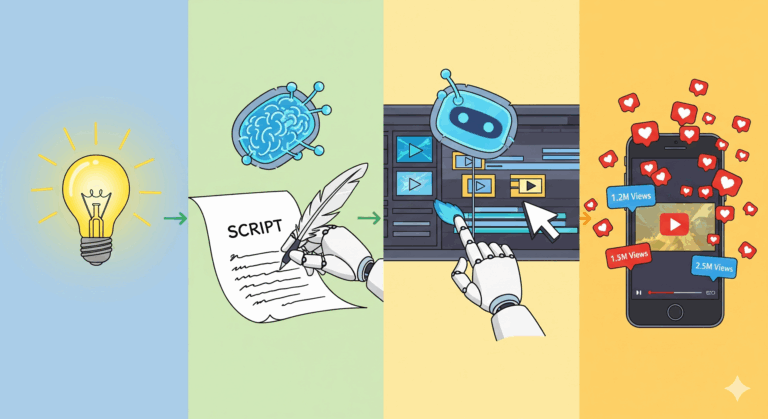
This workflow—from AI scriptwriting to AI voice generation and video assembly—transforms a weeks-long process into a matter of hours.
To learn the exact blueprint for this process, read our guide onAI-Powered YouTube Automation: How to Create Faceless Videos That Go Viral.
Chapter 4: The Ghost in the Machine: The Art of the Human Touch
As powerful as AI is, its default output can often feel… sterile. It can lack the warmth, wit, and unique perspective that makes content truly connect with an audience. This is where the modern creator’s most important job comes into play: being the editor-in-chief.
The biggest mistake is hitting “generate” and then “publish.” The crucial step in between is the “humanizing pass,” where you infuse the AI’s logical output with human emotion and brand personality. This involves protecting your brand voice by editing vocabulary and rhythm, and integrating unique stories and anecdotes that only you can provide. AI can report the facts; only you can tell the story.
Discover the essential techniques for this process in our guide,From Robotic to Realistic: 5 Secrets to Making Your AI-Generated Content Sound More Human.
Chapter 5: The Master Key: Unlocking AI with Prompt Engineering
Every tool discussed, every piece of content generated, begins with one thing: a prompt. Your ability to communicate clearly and effectively with an AI is the single most important skill in this new landscape. “Prompt engineering” isn’t a complex technical discipline; it’s the art of giving perfect instructions.
Let’s look at a quick before-and-after example for a blog post intro:
- Lazy Prompt: “Write an intro about prompt engineering.”
- Likely Output: “Prompt engineering is the process of structuring text that can be interpreted and understood by a generative AI model. It is a key aspect of using AI effectively…” (Accurate, but boring.)
- Strategic Prompt: “Act as a seasoned tech journalist. Write a compelling and slightly dramatic blog post intro about ‘prompt engineering.’ Frame it as the single most important, yet overlooked, skill for any modern creator. The tone should be authoritative but accessible. Start with a hook that grabs the reader’s attention.”
- Likely Output: “In the new world of generative AI, a simple truth has emerged: the quality of your output is determined entirely by the quality of your input…” (Engaging, contextual, and high-impact.)
Learning to “speak AI” fluently is like having a master key that unlocks the full potential of any tool you use.
Ready to become a master communicator? Dive intoThe Prompt Engineering Playbook: How to Write AI Prompts for Stunning Visuals and Viral Hooks.
Chapter 6: Navigating the New Frontier: The Ethics of AI Content Creation
With great power comes great responsibility. As you integrate AI into your workflow, it’s crucial to be a responsible and ethical creator. Keep three key areas in mind:
- Transparency and Disclosure: While you don’t need to slap a label on every AI-assisted sentence, being transparent with your audience about your use of AI builds trust. A simple disclosure in your blog’s footer or YouTube description can go a long way.
- Plagiarism and Originality: Reputable AI tools are designed to generate original content, but it’s still your responsibility to ensure your work is unique. Use plagiarism checkers and, more importantly, always add your own unique perspective to make the content truly yours.
- Copyright and Ownership: The legal landscape around who owns AI-generated content is still evolving. Be aware of the terms of service for the tools you use. For now, the safest approach is to treat AI as a tool that assists your original work, not as a standalone creator whose work you can claim.
Conclusion: You Are the Strategist, AI is Your Intern
The era of AI creation is not about handing over the reins. It’s about taking firmer control. The tools handle the what. You handle the why.
AI can write a blog post, but you decide on the content strategy that will attract your ideal customer. AI can generate a video, but you craft the narrative that will build a loyal community. AI can give you a thousand ideas, but you provide the vision and the ethics that define your brand.
To truly succeed, you need more than just a collection of tools; you need a unified strategy. That’s the entire philosophy behind The Viral AI Creator’s Kit. It’s the playbook that brings all these pieces—the tools, the human touch, the prompts, and the ethics—together, turning you from a simple AI user into a masterful creative strategist.
Welcome to the future of content creation. You’re in the pilot’s seat.